
- Blogs

- The Best Time to Take the NCLEX and How to Know You Are Ready

The Best Time to Take the NCLEX and How to Know You Are Ready
By Rachel Taylor, MSN, BSN, RN · Co-Authored by Jennifer Bonner, DNP, MSN, CNM, RN, SANE | Last Reviewed: September 14, 2026
The best time to take the NCLEX ® is when your practice results are reliably solid, regardless of how many weeks have passed since graduation. Most graduates are initially eligible two to six weeks after graduation, once transcripts clear and the Authorization to Test arrives. Once you’re eligible, the real question is “when am I ready?”
NCSBN’s most recent figures show first-time NCLEX-RN candidates pass at 86.7 percent, compared with 52.7 percent on a repeat attempt, a gap wide enough to take this decision seriously. This article covers when to take the NCLEX, the readiness signals, and how to determine your best test date. For registration steps, ATT processing, and state timelines, the graduation timeline article covers that in full.
The Best Month to Take the NCLEX After Graduation
When do you take the NCLEX? Most graduates test within that same two-to-six-week window once their ATT arrives, timed by how quickly your state board processes your file. Your first attempt runs on the ATT timeline, and validity windows vary by state, typically landing around 90 days.
The best month to take the NCLEX follows a pattern. A May graduate’s window usually lands in late June through July, keeping prep current while leaving room to build assessment evidence. Eyeing a residency start in July or August, or the first quarter of the year, keeps that window appealing too. When to take NCLEX comes down to your own readiness data more than the calendar. For the logistics behind the best time to take the NCLEX, see our article on when you can take the NCLEX after graduation.
What NCLEX Readiness Actually Measures in 2026
NCLEX readiness isn’t a percentage score. The exam is computer adaptive, so it adjusts each question’s difficulty to your performance and estimates your ability against a fixed standard instead of counting how many answers you got right. The NCLEX passing standard is measured in logits, a unit that reflects both question difficulty and test-taker ability on the same scale. That standard is set at 0.00 for NCLEX-RN and negative 0.18 for NCLEX-PN, both locked in through March 31, 2029. The exam stops once the algorithm reaches 95 percent confidence that your ability sits clearly above or below that line, which can happen anywhere between 85 and 150 items inside your five-hour appointment.
That’s why a single strong practice score, or a flat target like 60 to 70 percent, doesn’t tell you much on its own. What indicates readiness is performance that holds at or above the NCLEX passing standard across several assessments in a row. NCLEX readiness is built over time, and the next section walks through what that looks like in practice.
5 Signs You Are Ready to Take the NCLEX
Am I ready for the NCLEX? No single data point answers that. Weeks of study, a strong score, or an ATT doesn’t mean you’re ready to sit for the exam. NCLEX readiness is a pattern across several measures, not one result.
One Archer student’s own timeline shows what that pattern looks like in practice: “I graduated May 2024 and took the exam Nov 25 … PASSED the NCLEX for RN on my FIRST try !!! I did everything Archer told me to do, followed the 6-week schedule, answered all the questions using the Tutorial mode and then I resetted my Q-bank. After that, all I did was take the Readiness Assessments, CAT exams, study the rationales of each choices from each question and I felt very confident going into the exam.”
These five signs can help you find the best time to take the NCLEX.
Your NCLEX Readiness Assessment Scores Are Consistently High
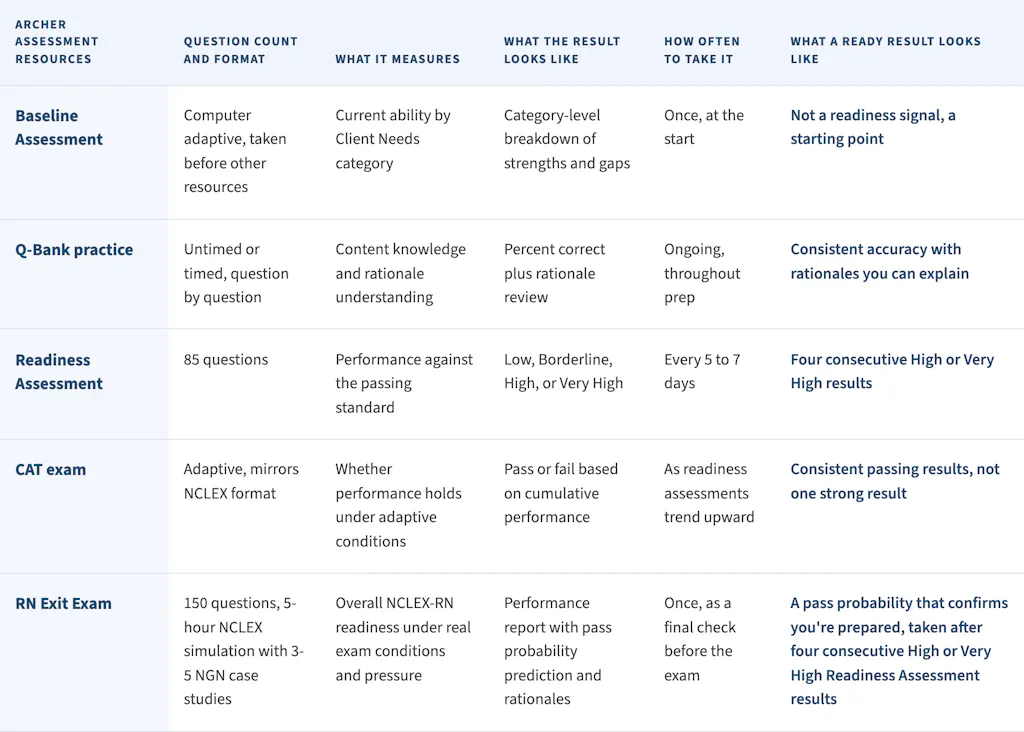
Your Archer readiness assessment scores are the clearest signal you’re ready. Archer’s Readiness Assessment is an 85 question test scored Low, Borderline, High, or Very High, and the benchmark is four consecutive High or Very High results before you schedule. Take one every five to seven days rather than cramming several into one week; frequent assessments predict success more reliably than one strong result, although this can vary based on the study plan you are actually following.
Consistency matters here. One Very High followed by two Borderline results tells a different story than four strong results in a row, even with a similar average. Consecutive results answer the real question: how many exams are enough before you can trust you’re ready. A strong pattern raises your confidence. It doesn’t guarantee a pass, but it’s the most concrete signal you have.
You Are Passing CAT Exams Consistently
A CAT exam and a Readiness Assessment measure different things. A Readiness Assessment shows where your performance sits against the passing standard. A CAT exam shows whether that performance holds up when the test keeps giving questions at the edge of your ability, the same way the real NCLEX does.
Make sure you’re passing consistently rather than swinging between pass and fail. Next, make sure you’re not thrown off by a hard question, that you’ve stopped reading your question count as a pass or fail sign, and make sure your focus holds through a full adaptive session. For how the adaptive algorithm actually selects questions, see how computer adaptive testing works.
Your Weak Content Areas Are Improving

Your overall score can hide the one thing that actually predicts readiness. Picture two candidates with the same average: one has stayed flat in Pharmacological and Parenteral Therapies for a month, while the other has climbed steadily in that category. The second is closer to ready, even if their overall numbers look identical.
Ask a few questions of your own data: are the same Client Needs categories weak every time, or improving between assessments? Do your misses come from missing content or clinical judgment? Can you explain why the correct answer is right? That distinction matters, since getting an item right by elimination and by reasoning look identical in a score report.
You Can Manage NCLEX Test Anxiety Across a Five-Hour Exam
Endurance is another readiness factor. The exam can run up to 150 items across a five hour appointment, testing something that short practice can’t. A stamina plan that’s just sitting in a chair for five hours sounds like a punishment, but it’s closer to the real exam than another content review. Watch for accuracy in the final third matching the first third, answering without reaching for notes, pacing that doesn’t force a rushed final block, anxiety that stays manageable, and NGN types like case studies, bowtie, matrix, and highlight questions feeling routine. Only a full-length timed simulation tests this. Three short sittings of 60 questions measure what you know, not whether you can hold it together for five hours.
You Know When You Should Take the NCLEX
When should I take the NCLEX? Not the day a Pearson VUE slot opens, or your ATT arrives; those are logistics, not readiness signals. A booked date helps you stay organized, but the real question is when in your prep that date should land. If the first slot comes too early, the NCLEX 30-day scheduling rule lets you decline it and pick a later date within your ATT window.
If your ATT arrives before assessments are consistent, book toward the window’s end and use the time on remediation. When do you take the NCLEX, then? As late as your window allows, not as early as your calendar allows.
Signs You Are Not Ready to Take the NCLEX Yet

Am I ready for the NCLEX? If you’re seeing any of these patterns in your own data, the honest answer is not yet.
- Results swing between assessments, one strong score followed by a weak one, rather than holding steady.
- You’ve treated one strong result as proof you’re ready, instead of waiting for it to repeat.
- You’re seeing repeated Low or Borderline scores on your Readiness Assessments.
- Your CAT results alternate between pass and fail rather than landing consistently on one side.
- The same categories keep causing trouble, assessment after assessment, with no movement.
- You’re racking up Q-Bank volume without reviewing the questions you missed.
- Performance drops off during long, full length exams compared to shorter practice sessions.
- NCLEX test anxiety regularly stops you from finishing a practice exam before time runs out.
- You’re choosing a date mainly because your ATT arrived, not because your data says you’re ready.
None of these predict a failing result on their own. They indicate the evidence for scheduling isn’t there yet, which is a different problem than not studying hard enough. You just need more data before you book.
NCLEX Readiness Checklist Before You Schedule
Am I ready for the NCLEX? Run through these eight questions honestly, using your own data rather than how confident you feel.
- Have you had four consecutive High or Very High Readiness Assessment results?
- Are your CAT results holding steady, not swinging between pass and fail?
- Have your weakest categories shown real improvement between assessments?
- Can you explain why the right answer is right, and each distractor wrong?
- Does your focus hold through a full length, timed exam without dropping off?
- Do NGN item types like case studies, bowtie, matrix, and highlight questions feel routine?
- Does your test anxiety stay at a level where you can still access what you know?
- Are you scheduling because your data says you’re ready, not because your ATT arrived?
If several are still a no, that’s not a reason to panic. It’s a sign your NCLEX readiness needs more evidence before you lock in a date.
What to Do While You Wait for Your ATT
Take the two to six week wait for your ATT to gather data to help you pick your test date. If you study broadly for two weeks and then find out pharmacology was the real gap, you lose valuable time from the only window where you’re fully in charge of your schedule. Start with a diagnostic instead, so you know where to spend your time most effectively.
Archer’s Baseline Assessment is built for exactly this. It’s a computer adaptive test that evaluates where you stand before you touch other resources, broken down by Client Needs category, so you know which categories need the most attention from day one.
From there, the sequence is straightforward: take the Baseline Assessment, remediate your weakest categories with focused review rather than broad review, run Readiness Assessments to measure whether that remediation is working, move into CAT practice once your Readiness Assessments trend upward, and do a final readiness check before you schedule. NCLEX readiness gets built in, not discovered on test day.
How Study Time Fits Into Your Test Date Decision
There’s no single study duration that determines readiness. Competitors quote four to twelve weeks depending on the candidate; Kaplan recommends six to eight weeks and 125 to 200 total hours. Those numbers are a starting point, but don’t account for where you’re starting from or how fast you improve your weakest areas. Personally, I recommend completing a study plan that ranges from 4 – 6 weeks of studying for the first time test taker.
What predicts readiness better than a week count is the improvement trend across your assessments. Two candidates who both study six weeks can land in very different places depending on whether their scores climbed steadily or stayed flat. For a full breakdown of how long to study for the NCLEX, map your prep window with the Archer NCLEX Study Calendar.
Does the 2026 NCLEX Test Plan Change Your Test Date?
No, it doesn’t. The 2026 NCLEX-RN test plan took effect April 1, 2026. Content categories and percentage ranges are unchanged from 2023, and CAT scoring, NGN item types, and the RN passing standard (0.00 logits) remain the same. Updates are limited to refined wording and a small number of new activity statements, including explicit expectations around unbiased care and equitable access, not structural changes to how the exam is built or scored. For the full breakdown, see 2026 NCLEX test plan changes.

Your 2026 NCLEX Readiness Timeline Step by Step
NCLEX readiness follows a sequence, and you move to the next step once the current one holds, not on a fixed schedule. Here’s what that progression looks like.
- Take a diagnostic before extensive review, and use it to identify your largest content and clinical judgment gaps.
- Remediate your weakest categories with focused review and rationale study, rather than raw question volume.
- Measure consistency across several Readiness Assessments in a row, not just one strong result.
- Confirm that performance holds up under CAT conditions, where the test keeps serving items at the edge of your ability.
- Look for several signals aligning at once, including four consecutive High or Very High results if you’re using Archer Review.
- Schedule once your assessments, CAT results, content trends, and stamina are all strong at the same time.
When should I take the NCLEX? Once every step above holds, not before.
NCLEX Myths That Lead to a Bad Test Date
When do you take the NCLEX? Some myths push candidates toward the wrong test date. Here’s what’s true.
Myth: finishing at 85 questions means you passed, and a long exam means you failed. Reality: the stopping rule is 95 percent confidence, not question count.
Myth: you must accept whatever Pearson VUE offers first. Reality: the NCLEX 30-day scheduling rule lets you decline it and pick a date within your ATT window.
Myth: one strong readiness result means you’re ready. Reality: NCLEX readiness comes from a pattern across several results, not just a single good day.
Myth: waiting longer always improves your odds. Reality: NCLEX pass rate data shows the opposite. Retention drops without structured preparation, and delay on its own doesn’t build readiness. Aim to test within 45 days.
NCLEX Timing and Test Date FAQs
How many practice tests should you pass before taking the NCLEX?
Aim for four consecutive High or Very High results on your Readiness Assessments, along with consistent CAT results. One strong test isn’t enough.
Is there a practice test percentage that means you’re ready?
No. The NCLEX is scored against an ability standard, not a percentage, and different platforms calculate their scores differently, so no single percentage applies across the board.
How many questions will you get on the NCLEX?
Between 85 and 150, depending on when the algorithm reaches 95 percent confidence in your ability. A longer exam isn’t a sign you failed.
When should I take the NCLEX if the ATT arrives before I feel ready?
Don’t schedule right away. Book toward the end of your ATT validity window instead, and use the extra time for targeted remediation on your weakest categories.
Does waiting longer improve your chances of passing?
Not usually. Retention drops the longer you wait without structured preparation, so when to take NCLEX matters more than simply delaying.
Choosing the Best Time to Take the NCLEX
The best time to take the NCLEX is the earliest date your own data supports, not a date picked off a calendar. Before you book, you want four signals working together: Readiness Assessments holding High or Very High across several results in a row, CAT exams passing consistently under adaptive conditions, your weakest categories showing real improvement, and your focus holding through a full length timed exam.
Archer’s Readiness Assessments and CAT exams give you exactly that evidence, so you’re scheduling off real data instead of a guess. Once those four signals line up, you’ve found the best time to take the NCLEX for you specifically, not a generic recommendation. Start your Archer NCLEX-RN prep and build that evidence today.